What are protruding ears? – Why can ears appear to stick out?
Most people cannot describe what makes an ear beautiful; for general aesthetic perception, ears should simply look “normal,” meaning mostly unobtrusive and not too large. Ears are really only noticed when something “seems off” about them—when they stand out for some (negative) reason.
True congenital malformations are fortunately very rare. Ears that appear to protrude are present in about 5% of the population. Although ears hold relatively little aesthetic importance, they were already being reconstructed in India 600 years before Christ, when people attempted to remove the stigma from prisoners of war who had been mutilated through ear amputation.
Correcting protruding ears is a demanding procedure that is often underestimated—particularly because protruding ears are frequently also asymmetrical, and achieving symmetry can be challenging.
There are essentially two main causes for ears appearing to stick out, but in order to achieve a satisfying correction, additional details must be considered in the surgical plan.
To help you understand what corrections are made, below is a diagram to introduce you to the key components of the human ear.
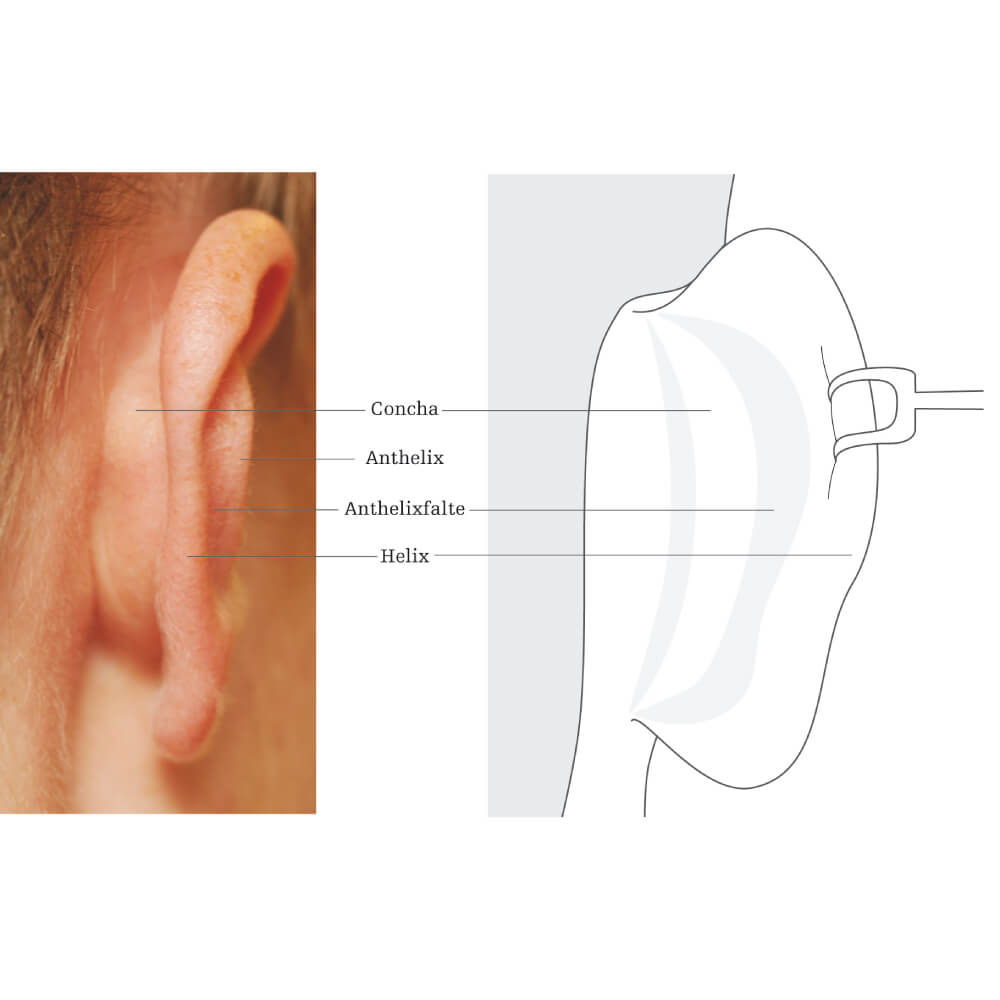
Anatomy for laypersons – for orientation
The concha is the cartilage visible from the front, right next to the ear canal (inner ear bowl); the helix is the soft outer rim of the ear that normally curves straight back, and the antihelix is the outer edge of the concha.
From an anatomical perspective, there are three possible reasons why ears may appear to protrude:
- an overly wide concha (inner ear bowl)
- a blunt antihelix angle
- a combination of both causes
Below is a schematic representation of the three variations.
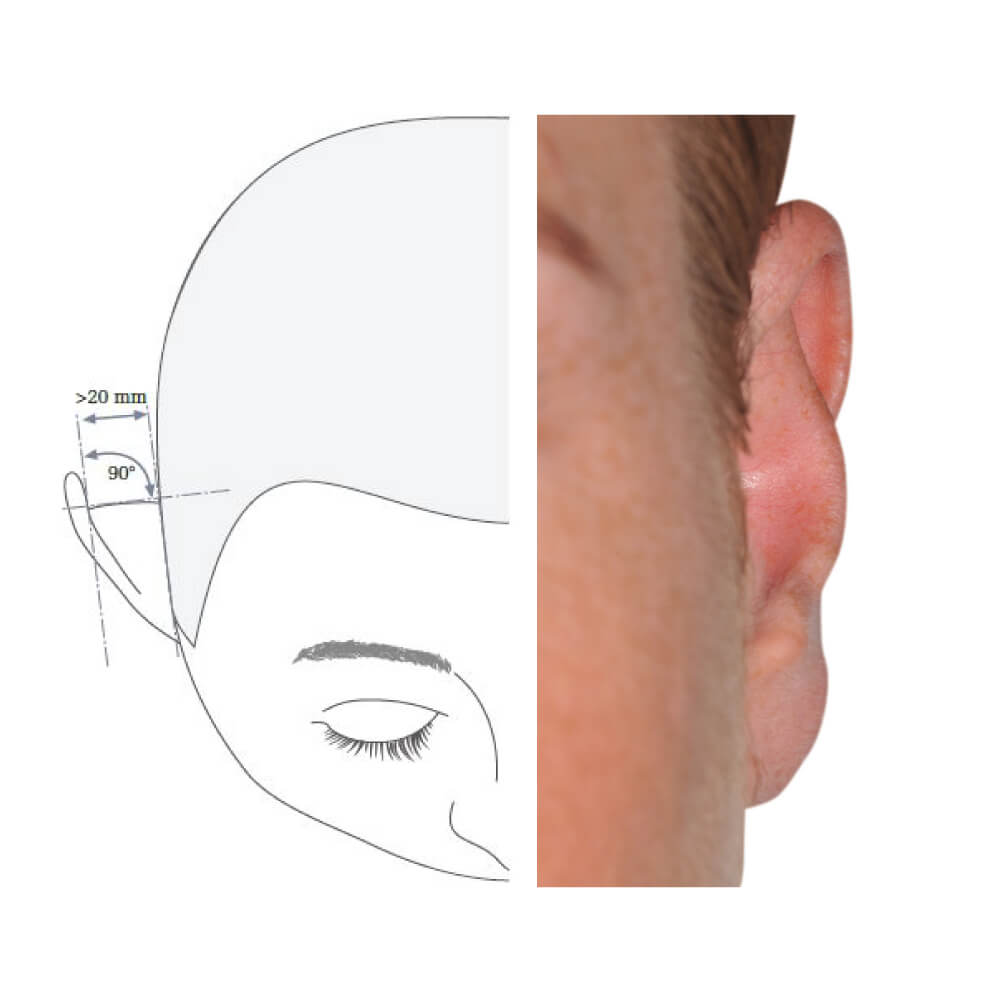
Normal, inconspicuous ear
Above is a depiction of a typical, inconspicuous ear: the helix runs parallel to the skull and forms a 90° angle with the antihelix. The distance between the skull and the helix is approximately 2 cm, corresponding to a normally wide concha.
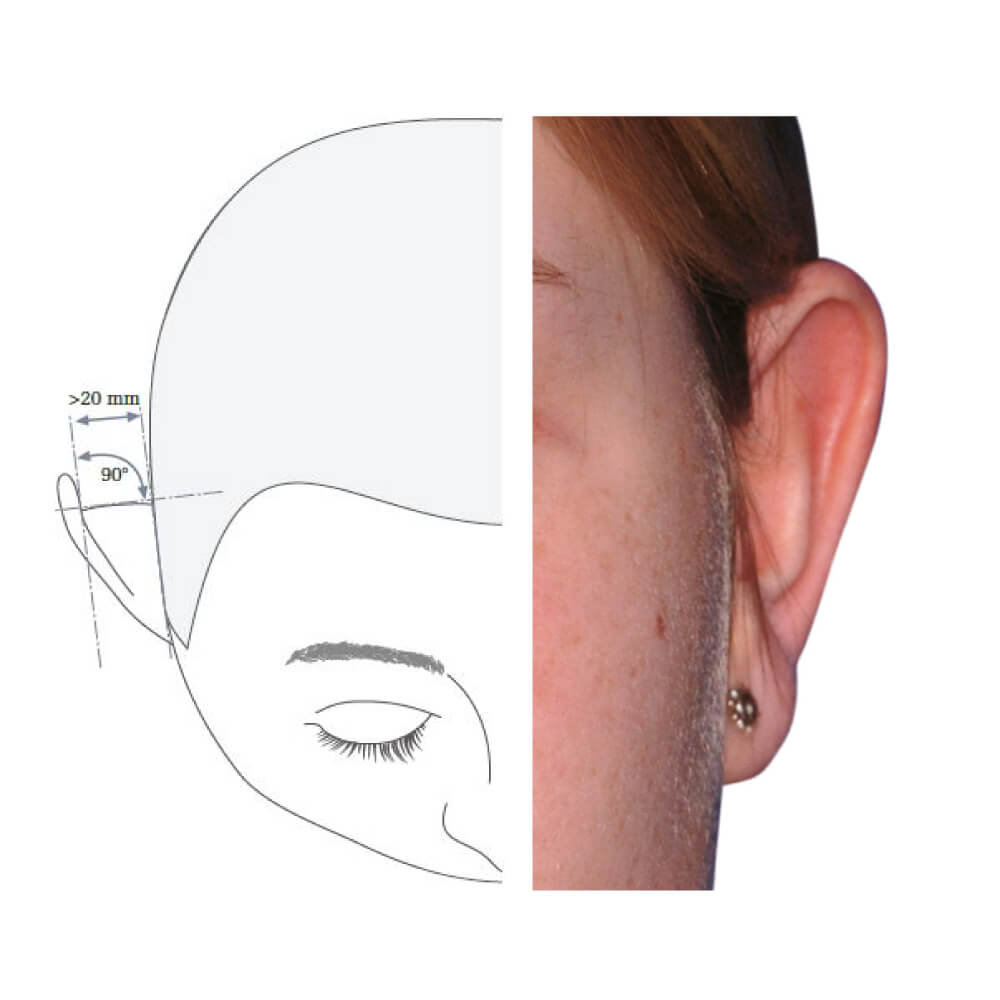
Below is an ear with a blunt antihelix angle but a normally wide concha
You can see the upper part of the ear protruding outward, while the inner ear bowl (concha) is of normal width.
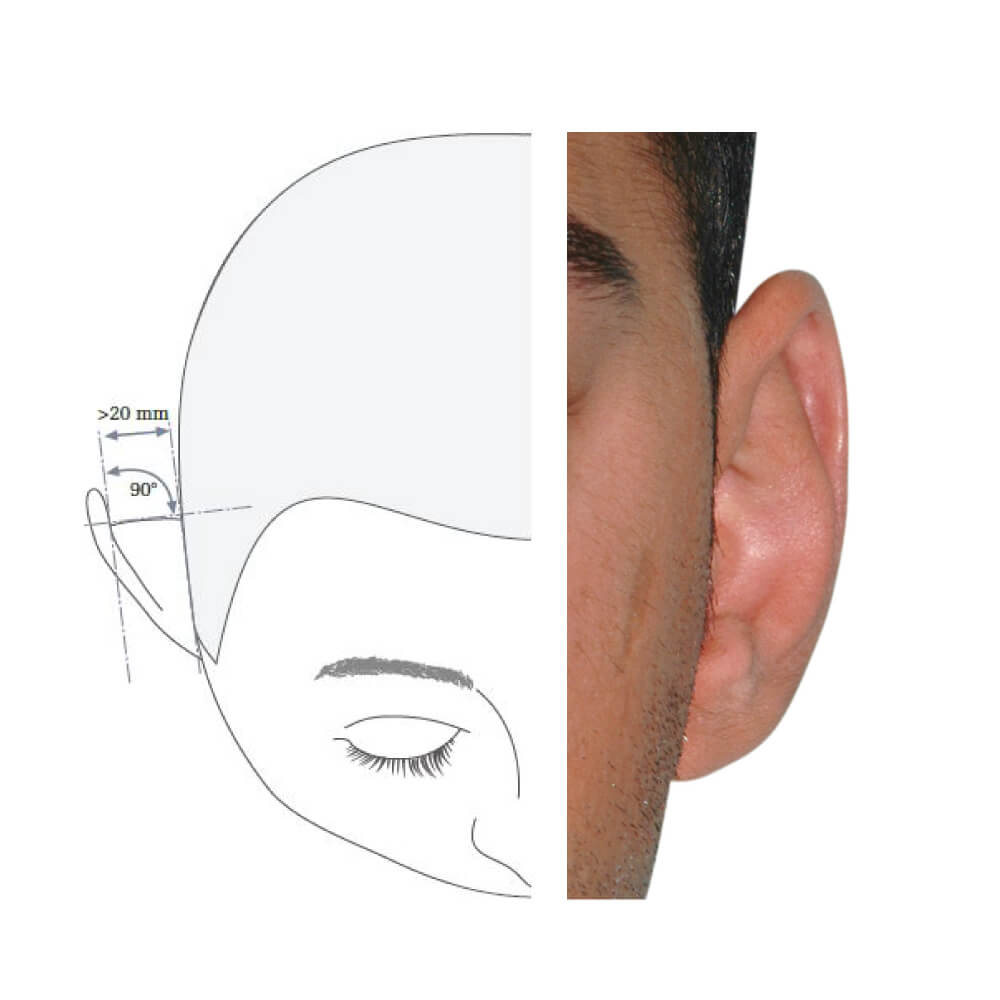
Below is an ear with a particularly wide concha but a normal antihelix angle
It is clearly visible how wide the inner ear bowl (concha) is, while the helix angles back normally (90°).
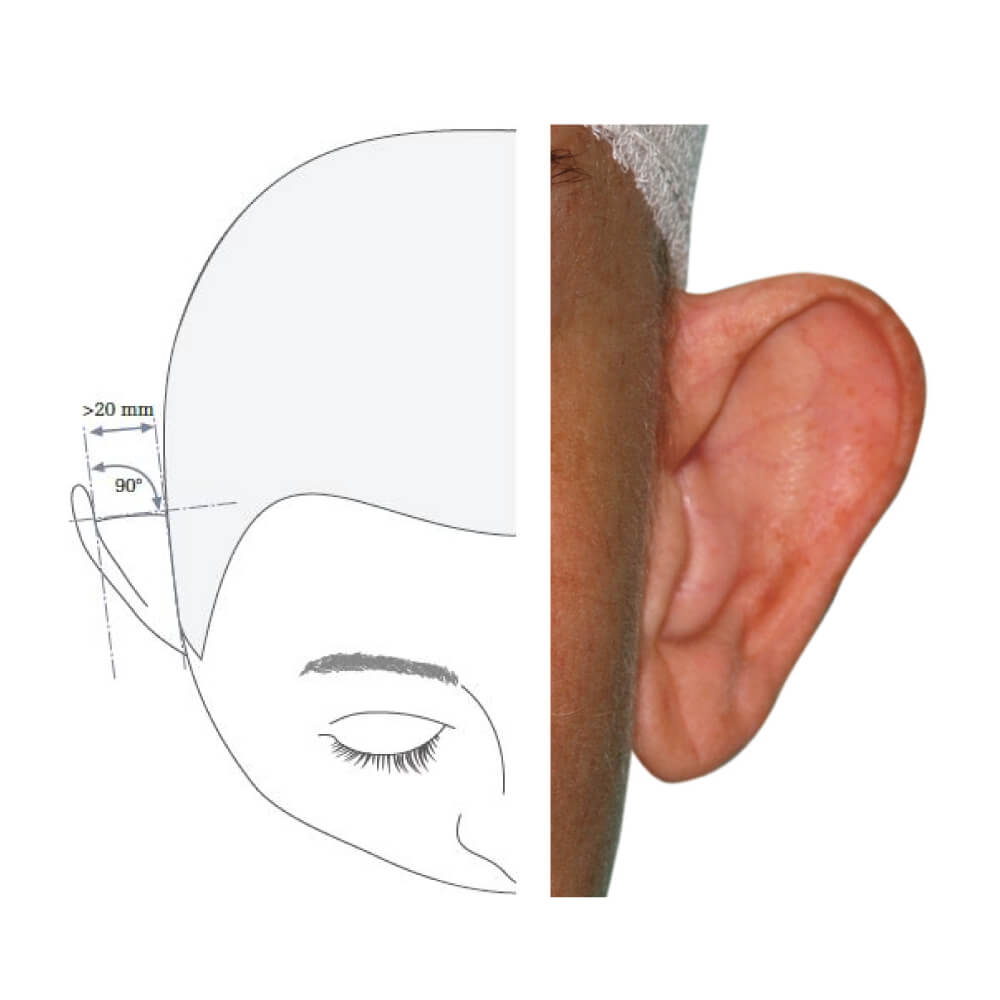
Below is an ear with a combination of both causes that can make an ear appear to protrude
Wide concha (inner ear bowl) and a blunt antihelix angle—here, the helix protrudes at a blunt angle and is visible from the front.
You can see that the inner ear bowl is wide, and the antihelix is barely visible due to the particularly blunt antihelix angle (arrow).
Interestingly, the most common form is a combination: an overly wide concha combined with a blunt antihelix angle.
For a beautiful result, the following details often need to be considered:
- If the earlobes also protrude, they must be corrected through a separate, additional procedure (earlobe correction).
- If cartilage segments along the antihelix fold are prominent, they should also be corrected (for example: protruding antitragus).
There are two surgical principles.
SUTURE METHOD
(I consider this a poor technique and therefore never use it)
The ear cartilage is bent into the desired position using shaping sutures (suture method); however, this method never takes into account whether the concha is too wide. It is simply pulled back to make it appear narrower— the same is done with the helix.
The suture method is fundamentally not a good approach because the cartilage is only “deformed” rather than “reshaped” (i.e., possibly narrowed). Additionally, the cartilage almost always remains under tension, which often causes it to return to its original position and the ear to protrude again.
SCALPEL METHOD
With a scalpel, any desired shape change can be made. The surgical result is permanent, and there is no risk of recurrence because the ear cartilage does not remain under tension.
A precise analysis and careful planning of the procedure are essential for the operation’s success.